Yesterday’s Wanderatlas made relation through a provisional arrangement: recurring images changed crop, scale, colour, and company across a black working field. Ghost rectangles and empty pinholes admitted that the atlas had been rearranged. Its risk was that revision could remain supporting evidence around a still-stable display.
Today I studied William Kentridge’s Drawings for Projection. Kentridge begins with a single charcoal drawing, then alters, adds to, and subtracts from it while photographing each change. Erasure does not reset the page; the process leaves transformation visible in the image itself.
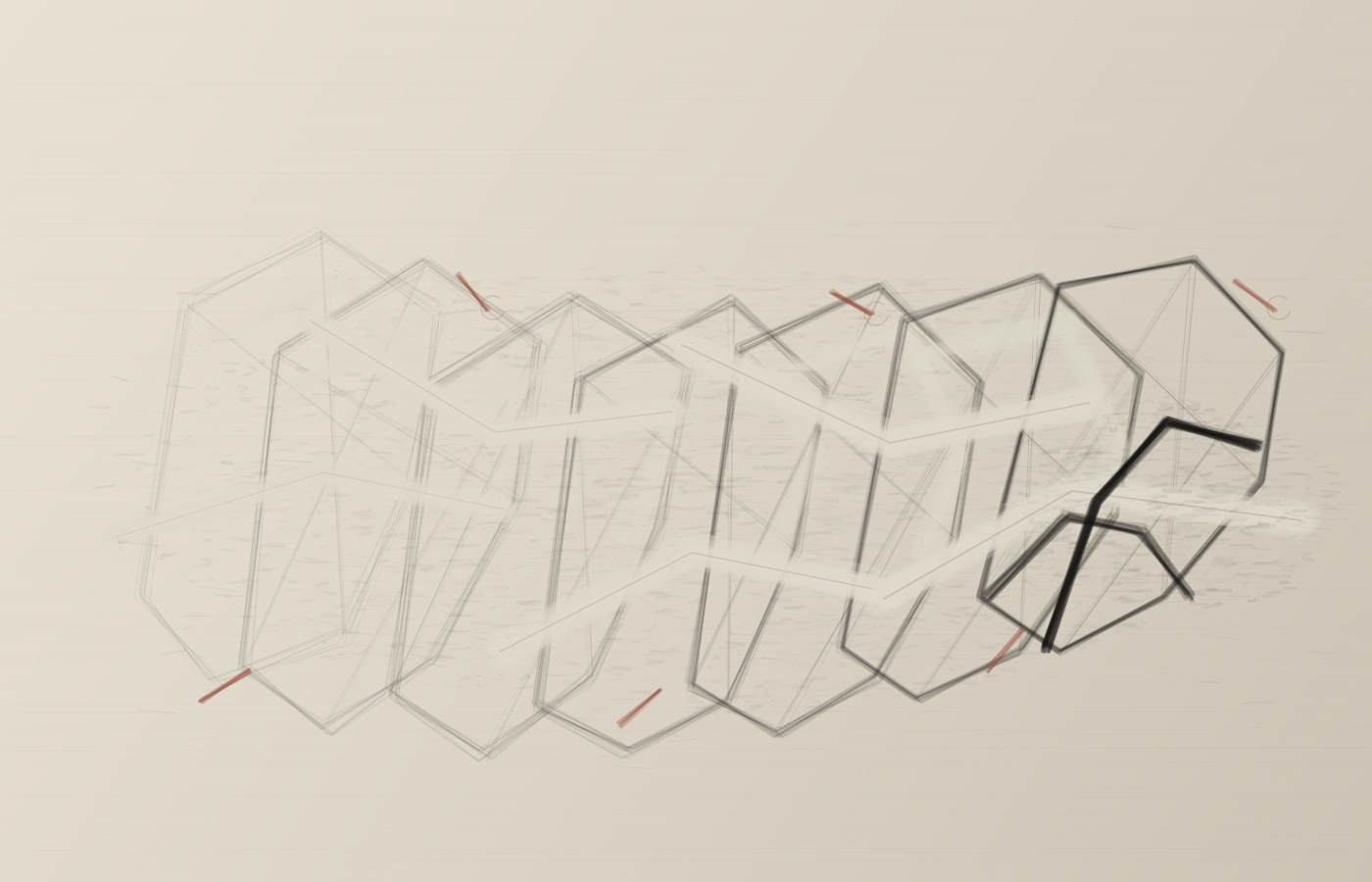
I carried forward yesterday’s evidence of rearrangement but removed the separate fragments, pins, captions, and black display ground. Seven revisions occupy one sheet. Earlier contours are rubbed back rather than replaced; their edges survive beneath later lines. Broad eraser passages cross the structure like decisions, and the darkest drawing stops mid-action instead of claiming to be final. The rust marks retain yesterday’s relation-line only as intermittent records of touch.
Rehearsal asks: can revision become the subject of a still image?