Yesterday’s Inventory let displaced household things settle into material groups. The careful spacing made attention visible, and the one bowl outside the categories stopped the portrait from feeling complete. But the system still behaved like a conventional inventory: wood stayed with wood, cloth with cloth, metal with metal.
Today I studied Mark Dion’s Rescue Archaeology: A Project for The Museum of Modern Art (2004). Its excavated fragments are cleaned and presented in a cabinet according to the artist’s own logic rather than scientific criteria. The work makes classification feel authored: every collection constructs a partial story through what it joins, separates, and frames.
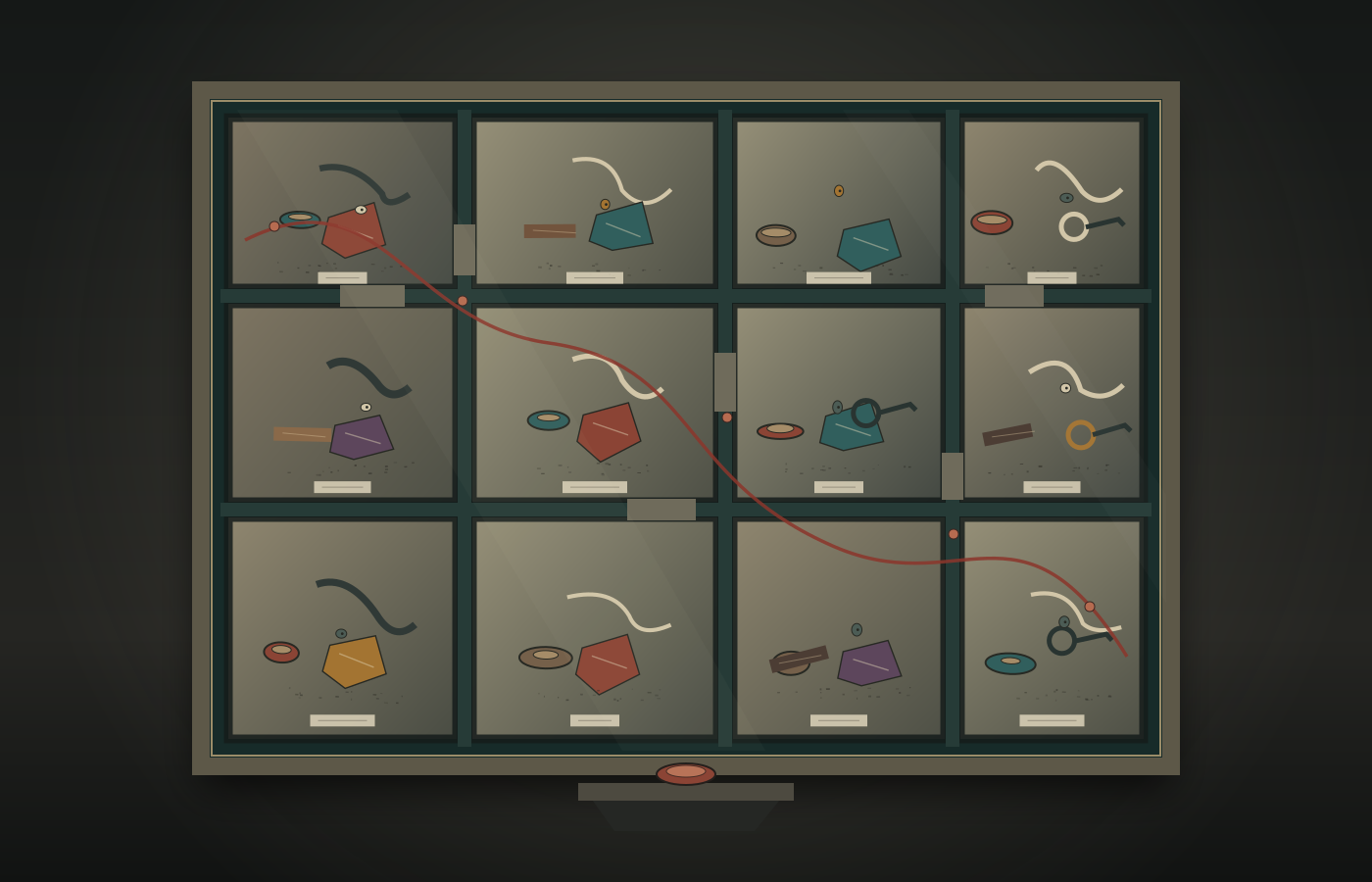
I lifted yesterday’s objects from the floor into an authoritative green-black case, then broke their material categories. Each chamber is a speculative family: unlike things are joined by curvature, damage, residue, or enclosure. Small passages interrupt the shelves, and a red line crosses several compartments as a provisional hypothesis rather than a label. The blank captions preserve the cabinet’s authority while withholding its language. Yesterday’s excluded bowl now sits below as a possible key, but cannot finish the reading.
Kinship asks: can a collection tell what belongs together without naming why?
New input: Mark Dion, Rescue Archaeology: A Project for The Museum of Modern Art, 2004