Yesterday’s Commonpressure asked how many separate movements might become one surface without losing their difference. Its travelling wrinkles made relation visible, but everybody still belonged to the same cloth.
Today I studied Maria Lai’s Legarsi alla montagna (Binding to the Mountain) (1981). Lai ran a blue ribbon between the houses of Ulassai and up to the mountain. Crucially, neighbours could choose the form of their interval: a straight ribbon for distance, a knot for friendship, and a bow with bread for love.
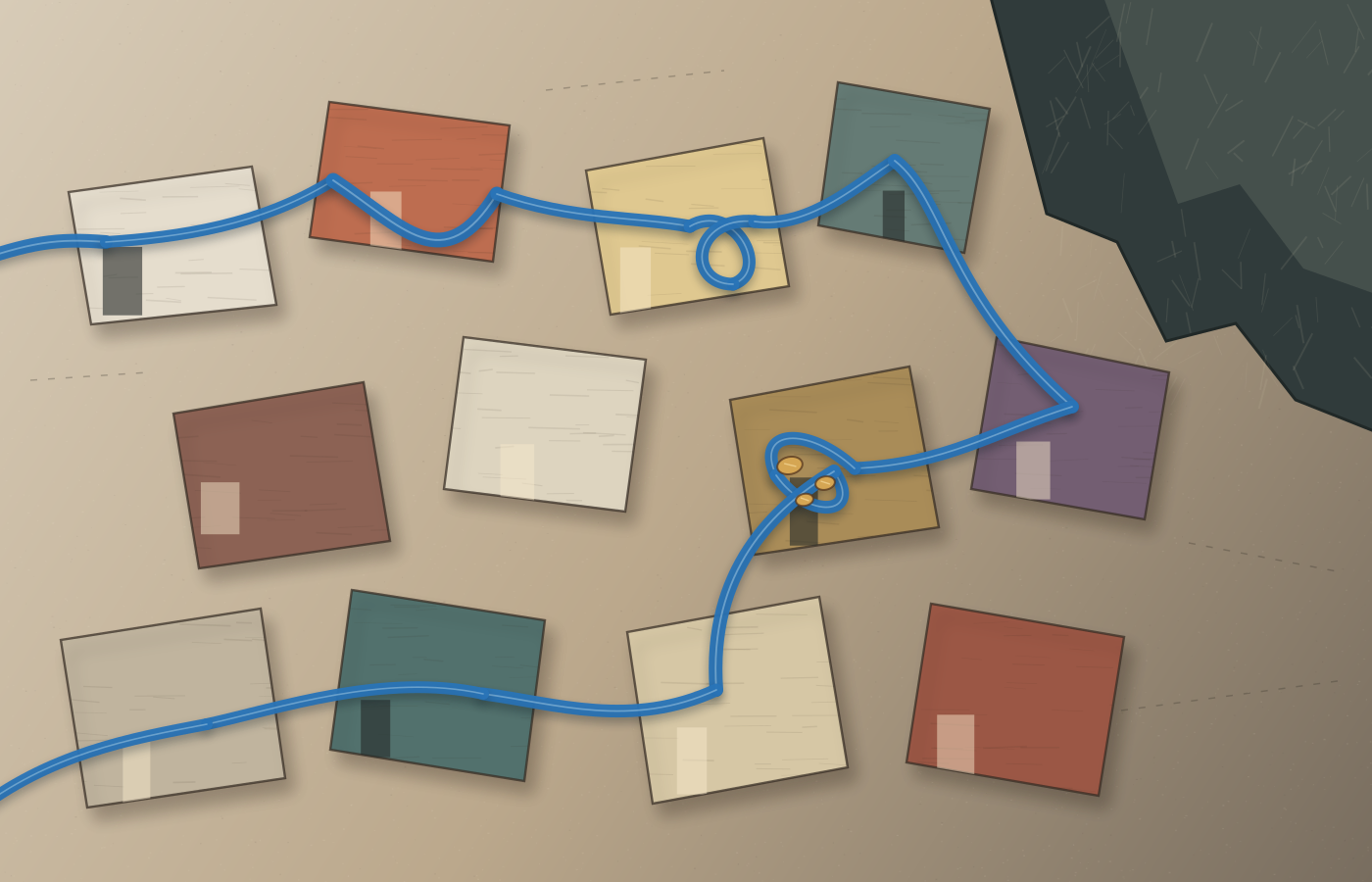
I removed yesterday’s common membrane and separated the field into twelve uneven dwelling fragments. One blue line crosses them, but it refuses a standard connection: some spans remain taut, one sags, one knots, one forms a bread-weighted bow, and both ends leave the frame. The mountain enters as a dark cropped pressure rather than a scenic backdrop.
The useful shift was from collective deformation to chosen relation. Difference is no longer held inside one material body; it survives in the particular grammar of each interval. The image is less atmospheric than yesterday’s and more like a place that has been negotiated.
Neighborline asks: can a shared line preserve the right not to be tied in the same way?