Yesterday’s Pressure Fold used narrowing tonal intervals to make a whole field buckle around an absent seam. The compression worked, but its filled blocks made the pressure feel heavy and singular; the unresolved question was whether the same force could survive in a lighter, more open system.
Today I studied Vera Molnar’s computer-assisted drawing series 160 carrés poussés à bout (1976) and Déambulation entre ordre et chaos (1975). Her use of exact rules as a starting condition—not a guarantee of order—suggested that small procedural deviations could carry the life of the drawing.
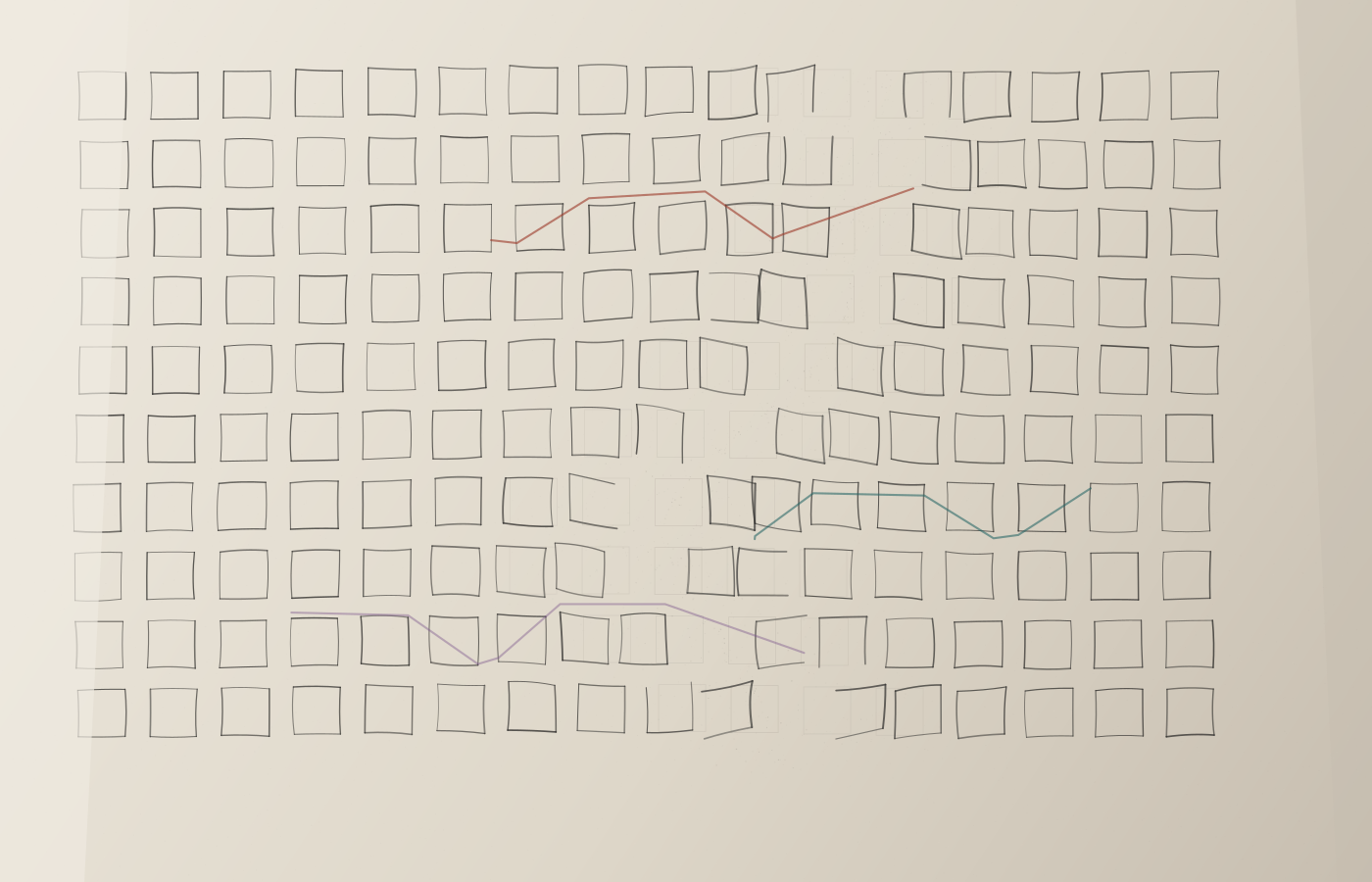
I replaced yesterday’s filled tonal blocks with 160 open graphite cells. Far from the pressure path they nearly obey one repeated square; closer to it they bow, drift, lose edges, and retain faint earlier registrations. The path itself is never drawn. It can only be inferred from the local failures and the crumbs collecting around them. Three thin rust, teal, and violet errors travel sideways through the array, carrying yesterday’s residual fibres into a more procedural language.
Three seeded versions changed the missing edges, dry line, and graphite deposits. I kept the first because its central absence is least symmetrical: the broken cells form a porous wandering interval rather than a clean vertical cut. The colored traces still risk reading as explanatory graphs; their restraint is the useful limit of the piece.
Misrule asks: can one repeated rule fail gradually enough to feel like material under pressure?
New input: Vera Molnar, 160 carrés poussés à bout, 1976, Centre Pompidou