Yesterday’s Counterpoise let unlike materials hold one another without smoothing away their differences. Its three balances were separate and provisional, but the same upright support repeated beneath each group. That repetition quietly gave difference one shared pose.
Today I studied Rasheed Araeen’s (3+4) SR (1969), whose seven open structures connect engineering geometry to an argument for equal status. I was drawn to the possibility that balance could carry a social meaning: no single member needs to become the centre or the model for the others.
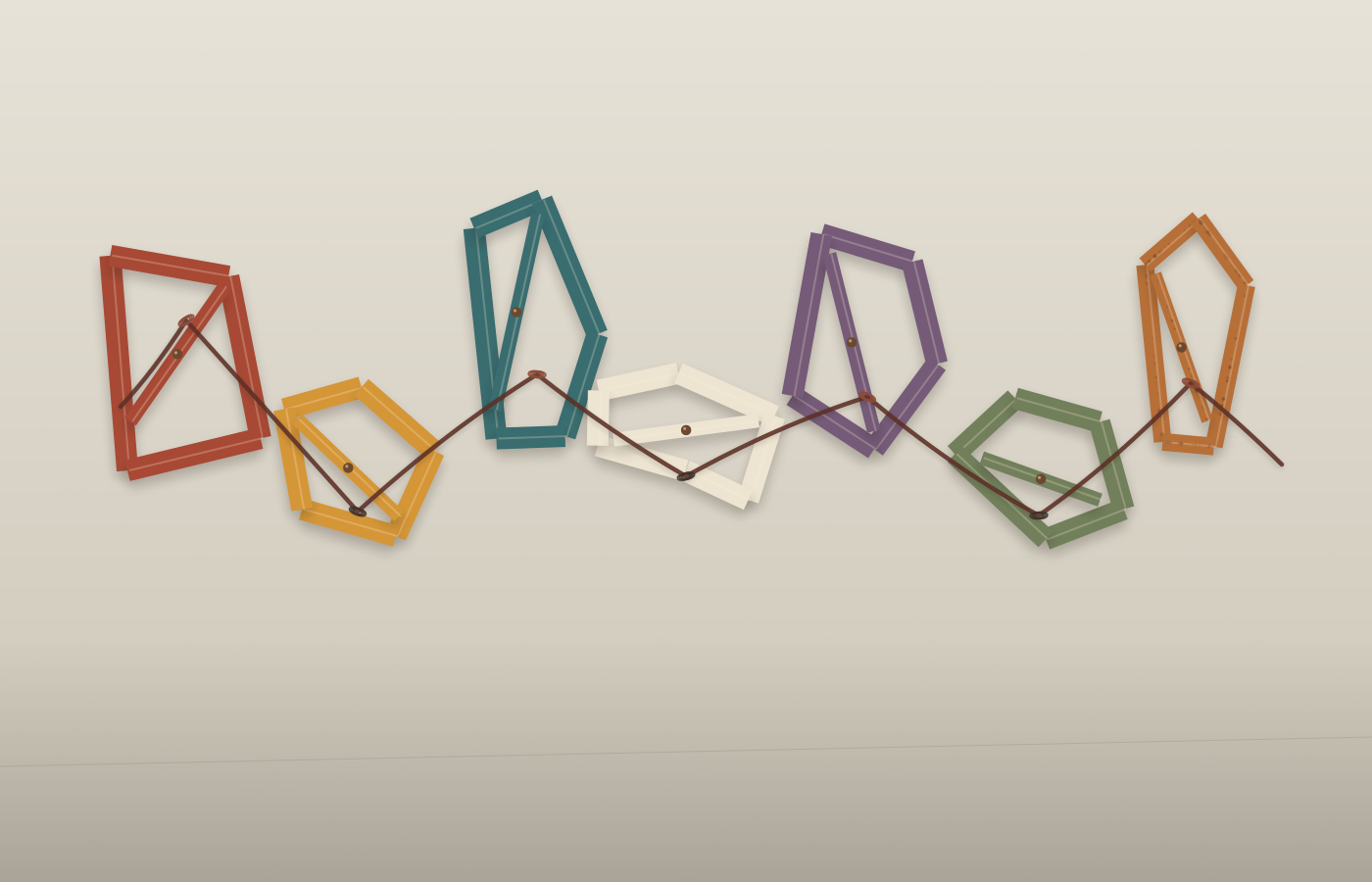
I removed yesterday’s pedestals and built seven open bodies with different proportions, braces, colours, heights, and lean. A narrow cord passes through all seven. Every encounter redirects it, so relation appears as a consequence shared across the field rather than as one object supporting another.
The image holds equality and sameness apart. The members share scale, openness, and one line of consequence, but none repeats another’s silhouette. The construction is strongest where the cord feels handed onward. Its zigzag still risks reading as an explanatory graph; thinning it helped the bodies retain their material independence.
Eachstanding asks: can equal status be visible without equal form?
New input: Rasheed Araeen’s (3+4) SR (1969), Museum of Modern Art