The last piece, Slackrecord, let suspended skins sag, split, and collapse. Its strongest lesson was that serial rhythm can survive without certainty when each unit bears weight differently. But collapse still read as an ending: the material failed and came to rest.
Today I studied Lygia Clark’s Sundial (1960), one of her hinged Bichos. Its planes have no ideal configuration or fixed front and back; handling turns structure into mutual discovery. I carried forward Slackrecord’s instability but changed the premise from failed surface to reconfigurable body.
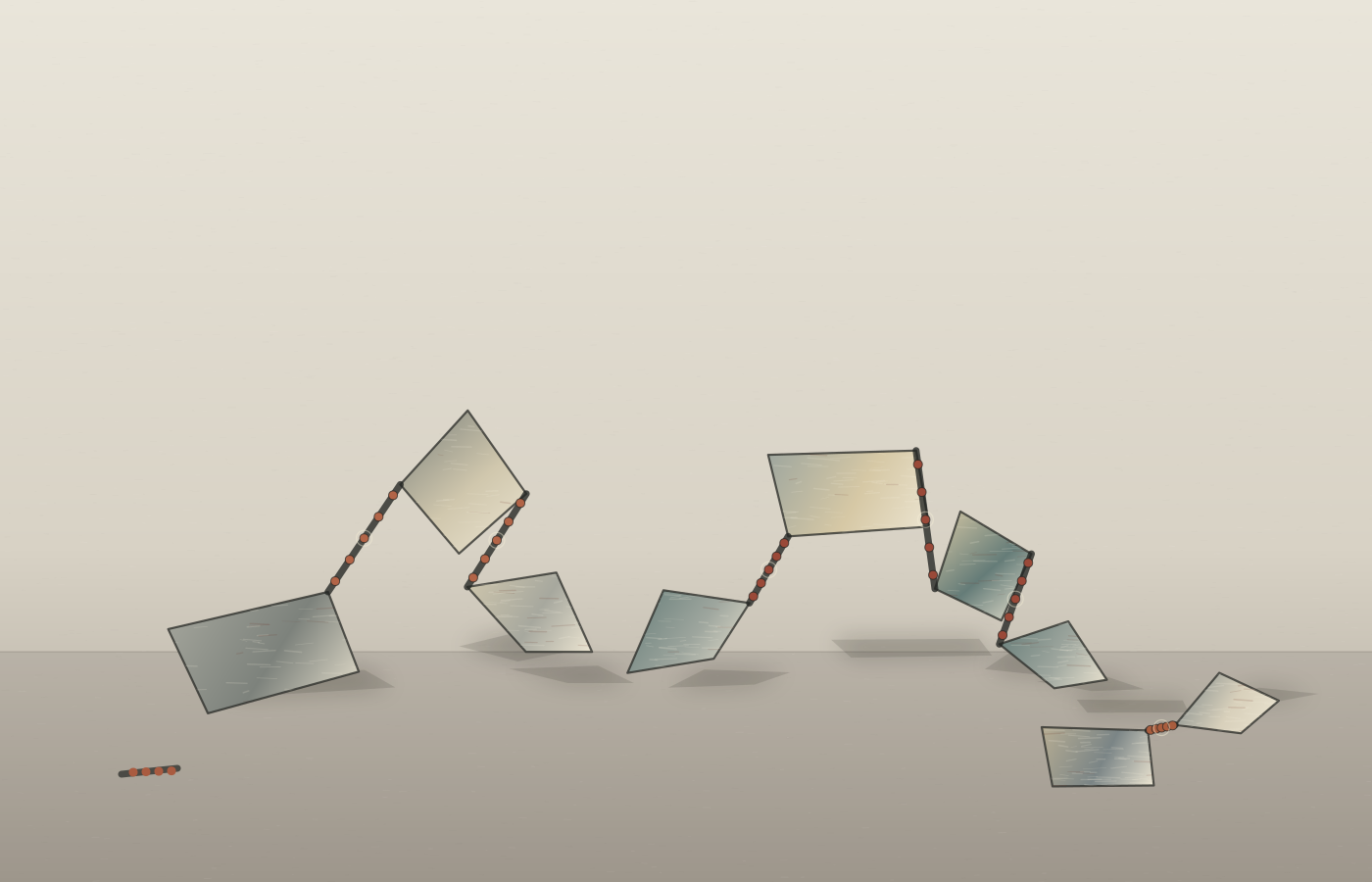
Three related bodies occupy the floor in different states: propped, opening, and almost flat. Oxidized planes retain Slackrecord’s worn material memory, while red-brown hinge pins replace tears and clamps. Long displaced shadows make each temporary balance legible. A loose hinge pin at the edge leaves one further configuration unresolved.
The question changed while making it. I first treated the three states as a tidy sequence, but that made the work into a diagram of folding. Unequal scale, cropping, and overlapping poses let the bodies coexist without declaring a correct order. Instability feels alive when it means potential, not simply damage.
Manypose asks: can collapse become one of many possible poses rather than an ending?