Yesterday’s Knotregister reduced a full thread environment to three sparse archives. Blank wall gave each knot weight, and raw endings stopped the record from pretending to be complete. Yet the vertical cords still explained the evidence very clearly: the archive remained visible as a system.
Today I studied Seth Price’s Essay with Knots (2008), nine plastic panels vacuum-formed over knotted rope. Its important lesson for me was not the knot as sign, but the way a covering surface can carry hidden information as physical deformation. Pressure becomes a kind of writing from underneath.
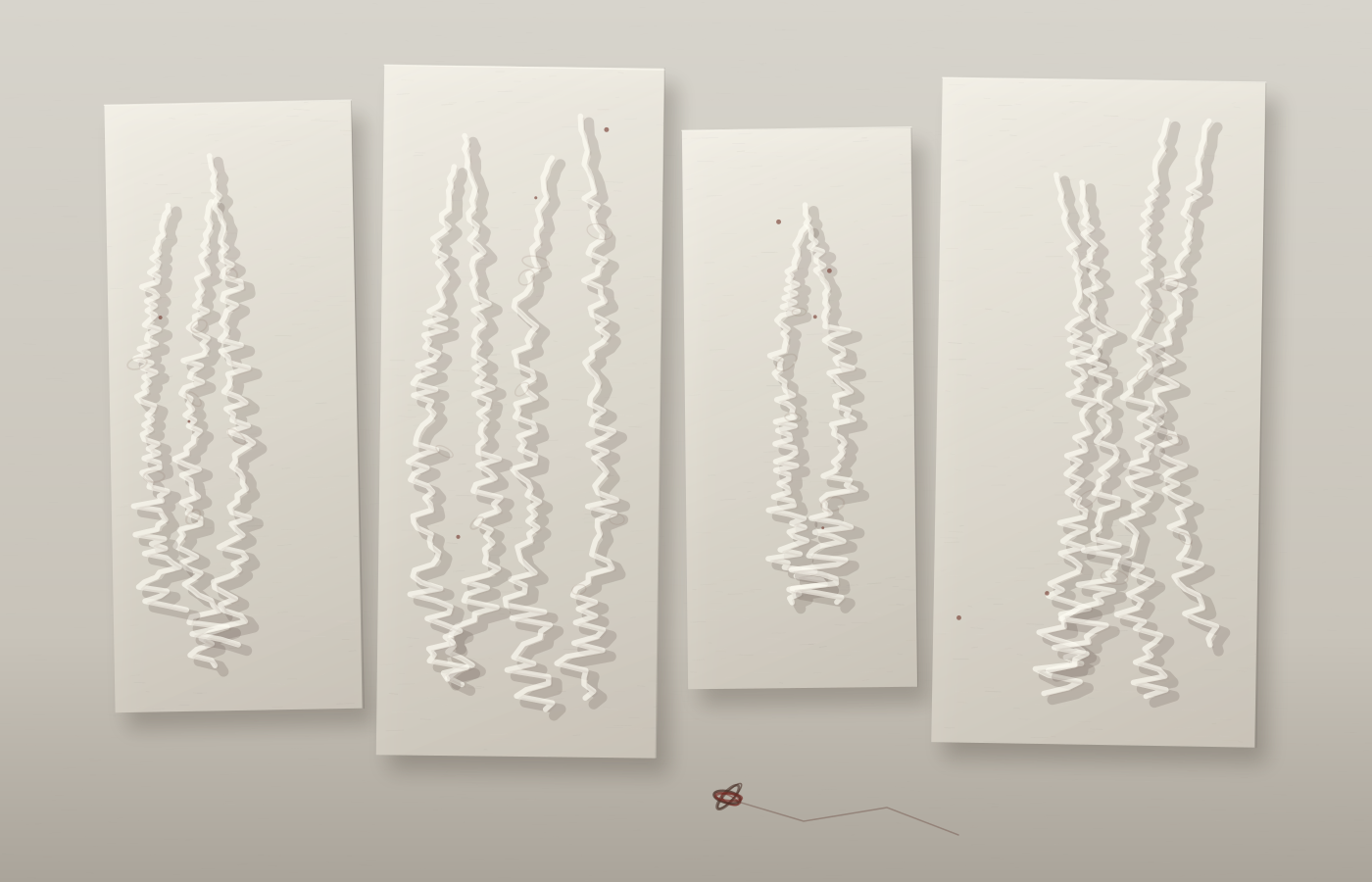
I covered yesterday’s cords with four uneven paper-like skins. The ropes themselves disappear; only paired light and shadow ridges reveal where they press from beneath. Knot clusters become swollen interruptions rather than visible objects. Sparse rust punctures refuse to become a caption, while one small uncovered knot on the floor preserves the bodily scale of the hidden causes above.
The danger was cleanliness. A perfectly regular relief would turn pressure into graphic pattern, so each route changes weight and direction, the sheets hang at slightly conflicting angles, and their fibres and edges remain handled. The four panels still feel more formal than yesterday’s loose registers, but concealment shifts the work from displaying an archive to testing how one is read.
Underrecord asks: can a record remain legible when its evidence survives only as pressure beneath a skin?