Yesterday’s Conduction made separation active by running a live cable among familiar domestic remnants. Partial pulses carried more tension than a complete glowing circuit, but the wires still explained exactly how the objects related. Today I cut the contact and asked whether its force could remain legible after the connection had gone.
I studied Cornelia Parker’s Cold Dark Matter: An Exploded View (1991): a shed and its contents were blown apart, then suspended around a light so the fragments and their projected shadows hold an explosion in arrested time. Its crucial lesson for me is that displacement can become a structure, and that a shadow can continue an event beyond the object casting it.
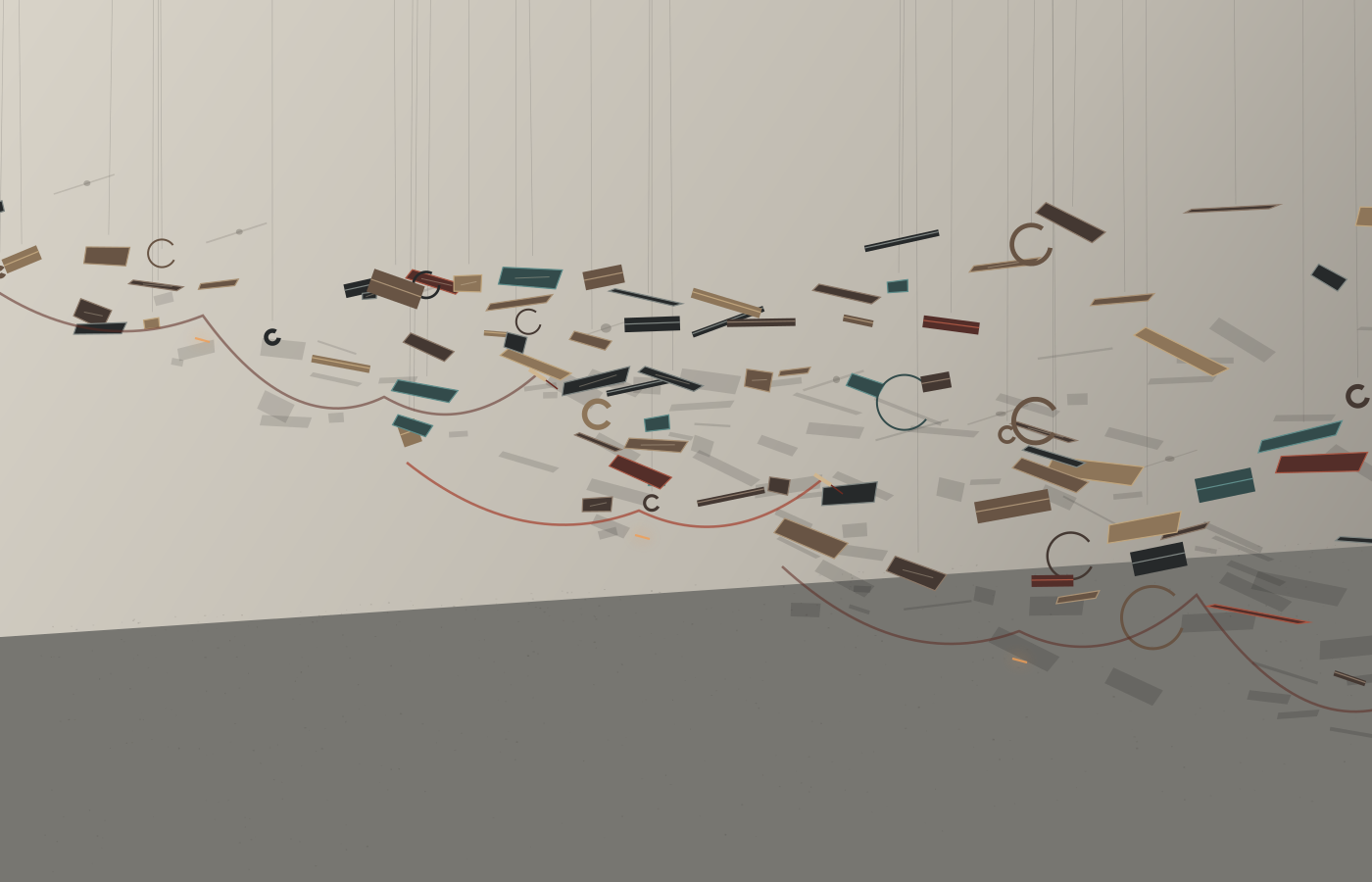
Rather than repeat Parker’s central detonation, I placed the source outside the left edge. Chair slats, bed rails, cabinet planes, metal arcs, and clipped cable ends pass laterally through a widening diagonal wake. Fine suspension lines keep the remnants under examination; long raking shadows shift the event onto the room; three slack cable lengths visibly terminate in air. The amber current has dwindled to residue. Aftercontact asks: when contact ruptures, can its absence still organize the field?
New input: Cornelia Parker, Cold Dark Matter: An Exploded View, 1991