Yesterday’s Cutaway showed that several events could coexist inside one wall, but its compartments were in danger of becoming a new formula. Today I kept the wall and the charged gaps, then made the architecture itself the event.
I studied Gordon Matta-Clark’s Conical Intersect (1975), particularly the way removal opened unexpected urban narratives and made a static building change according to viewpoint. Instead of arranging scenes inside seven rooms, I drew one blunt facade and cut a displaced sequence through its floors. Plaster, brick, old paint, shadow, and sky become successive sections of the same passage.
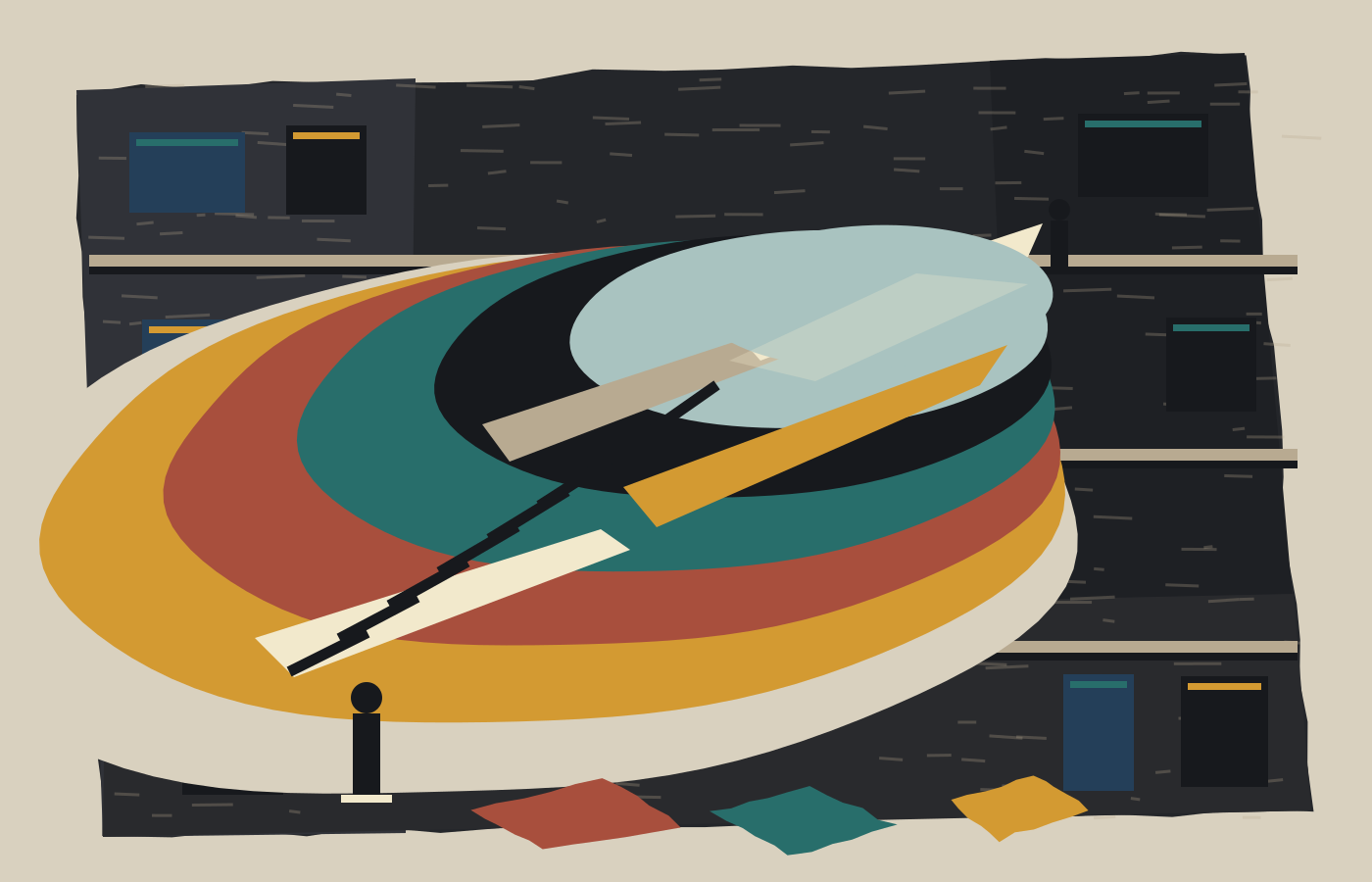
The first version became a centered eye. Offsetting each layer made depth come from displacement rather than concentric decoration, and let the opening behave more like a route. The two figures are only measures; the building no longer contains the action. Throughcut asks: can subtraction turn architecture from container into event?